


THE PALACE OF FINE ARTS

The Palacio de Bellas Artes ("Palace of Fine Arts") is a prominent cultural center in Mexico City. It hosts performing arts events, literature events and exhibitions (including important permanent Mexican murals). "Bellas Artes" for short, has been called the "art cathedral of Mexico". The design of the building is a mix of styles; Art Nouveau dominates the exterior and Art Deco, the interior.

We visited the palace with our ToursByLocals guide Jose Luis to focus on the murals of Rivera, Siqueiros and Orozco. I honestly cannot say I had ever previously studied murals with the same intensity as we did with Jose Luis; he left us with a much deeper appreciation for murals and the political messages they strive to convey to the viewer.
Diego Rivera's murals including "Man, Controller of the Universe", was originally commissioned for New York's Rockefeller Center in 1933. The mural depicts a variety of technological and societal themes (such as the discoveries made possible by microscopes and telescopes) and was controversial for its inclusion of Lenin and a Soviet May Day parade. The Rockefellers were not happy with the political messaging of the mural and the incomplete work was eventually destroyed and painted over. Rivera recreated it for the Palace of Fine Arts in 1934.

Another work by Rivera that we took in was Carnival of Mexican Life (1936).


True to the theme of a "carnival" masking a dark political reality, Rivera is satirizing the history of oppression in Mexico:
The Dictator: The central figure at the top on horseback is a caricature blending elements of various Mexican military dictators; he wears a ridiculously exaggerated, colorful carnival headdress over his military uniform, waving a sword.
The Deception: Below him, an indigenous man with traditional facial paint holds a dagger and a spiked shield, while another figure plays a stringed instrument. Rivera is showing how the military dictatorship manipulates national identity, folklore, and indigenous culture as a distracting "carnival performance" while simultaneously exploiting the people.
We all know Diego Rivera (and his famous wife, Frieda Khalo), but David Alfaro Siqueiros was a new artist for me to learn about. Siqueiros was a member of the Mexican Communist Party. He traveled to Europe in 1919 to expand his studies in art. First in Paris, he absorbed the influence of cubism, intrigued particularly with Paul Cézanne and the use of large blocks of intense color. While there, he also met Diego Rivera. He went to Spain to support the Spanish Republic against the forces of Francisco Franco with his art, he volunteered and served in frontline combat as a Lieutenant Colonel in the Army of the Republic through 1938 before returning to Mexico City. In 1940, he led a failed assassination attempt on Leon Trotsky in which Trotsky's 14-year-old grandson was shot.
Siqueiros' three-part "New Democracy" was commissioned in 1944 to commemorate the victory of the Allies over the Axis powers in World War II. This massive triptych is dominated by a central allegorical figure bursting with raw energy; a bare-breasted allegorical representation of humanity—often interpreted as a personification of liberty or democracy. She wears a Phrygian cap (a classic symbol of freedom) and is shown forcefully breaking out of heavy iron chains. The mural was a direct, celebratory response to the fall of global fascism, capturing a profound sense of relief, triumph, and the rebirth of human dignity after years of devastating global conflict.

While the central panel is an explosion of hope, the two flanking panels added a year later (1945) serve as a sobering, brutal counterweight:
The Victims of War (Las víctimas de la guerra): Depicts a mass of dead, mangled bodies, underscoring the horrific human cost paid to achieve victory.
The Victims of Fascism (Las víctimas del fascismo): Shows a bound, tortured figure, reminding the viewer of the specific cruelty and oppression that had to be overcome.

The elements of this image:
Why Siqueiros Made It So Shocking:
While Diego Rivera often painted history with a sense of narrative hope and epic scale, Siqueiros wanted his viewers to feel visceral pain. By creating a composition that forces you to look directly at a mutilated, screaming body intertwined with weapons, he ensures nobody can celebrate "Democracy" without remembering the horrific human cost and the fascism that crushed innocent lives to get there.

The human figures aren't just tied up; they are physically trapped, crushed, and intertwined with heavy, metallic industrial machinery, gears, and pipes.
"Whipping Boy"(1947) by Siqueiros, is a powerful mural showing a figure who is dramatically angled, with massive, bound fists thrust directly into the foreground. Siqueiros utilized this radical perspective to make his subjects feel monumental, aggressive, and exploding out of the frame toward the viewer. He pioneered the use of industrial materials—such as pyroxylin (an automotive paint) and thick, heavily textured impasto—to give the flesh and the stone a gritty, deeply physical, and tactile quality.

The Apotheosis of Cuauhtémoc was painted by David Alfaro Siqueiros between 1950 and 1951. We see a Spanish conquistador in full, cold metallic armor. Next to him is a surreal, multi-legged, mechanical-looking centaur creature collapsing and being pierced by a spear. Siqueiros is using imagery from the Spanish Conquest but giving it a modern, sci-fi twist. The centaur represents the Spanish invaders (who rode horses, a terrifying sight to the Aztecs), but Siqueiros renders the horse as a machine of war, symbolizing how technological imperialism crushes indigenous cultures. The "apotheosis" implies a spiritual elevation or vindication of Cuauhtémoc, the last Aztec emperor, even in defeat.


In "The Torment of Cuahtemoc" (1950 and 1951) by Siqueiros we are witnessing an infamous historical account of the Spanish conquistadors torturing the last Aztec emperor, Cuauhtémoc, and his cousin, the lord of Tlacopan. Their feet are being burned in a fire to force them to reveal the location of hidden Aztec gold.

Elements to take in from this mural include:
Cuauhtémoc’s Stoicism: Cuauhtémoc looks on the left, staring stoically forward despite the flames on his feet. Siqueiros paints him as a symbol of unyielding indigenous strength and dignity under absolute brutality. Next to him, his cousin looks upward in agony, pleading for mercy.
The Oppressors: On the right, the Spanish soldiers are depicted in cold, rigid, unfeeling golden armor. To emphasize their cruelty, Siqueiros includes an aggressive, snarling war dog held back by one of the guards, adding to the terrifying, claustrophobic atmosphere of the interrogation.
The Weeping Woman: On the far left, a woman in red raises her arms in utter despair and grief, symbolizing the broader trauma and suffering of the indigenous population during the fall of Tenochtitlan.
Takeaways comparing the style of Siqueiros vs. Rivera:
Diego Rivera: Rivera favored traditional Italian fresco techniques on wet plaster. His lines are clean, the surfaces are smooth, and the figures are arranged in a flatter, more illustrative, folk-art-inspired layout.
David Alfaro Siqueiros: Siqueiros used thick, violent, automotive paint (pyroxylin) with explosive, three-dimensional muscular distortion rushing out at the camera.
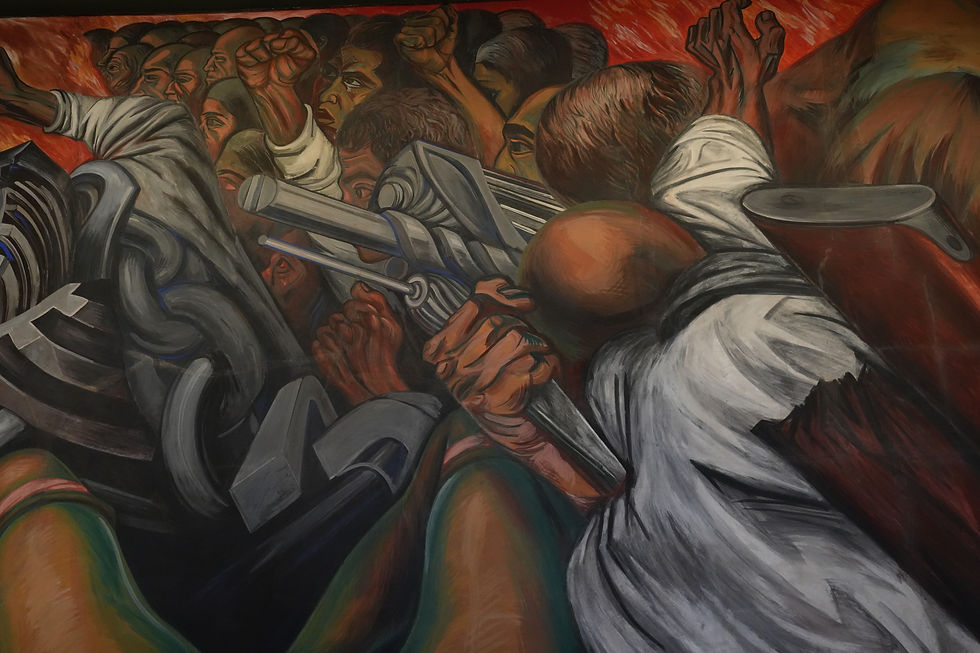
The third artist among the prominent trio of muralists is Jose Clemente Orozco. His mural, "Catharsis" (1934), shares thematic similarities with Siqueiros' "New Democracy." Orozco presents a cathartic depiction of a dystopian world plagued by conflict, decay, and destruction. He illustrates an industrialized, war-torn society featuring protestors, combatants, and a backdrop filled with cogs, weapons, and machinery. To the left of the mural's center, a laughing prostitute is portrayed lying on her back.
"Catharsis" marked Orozco's first public fresco after a seven-year stay in the United States. The mural was influenced by Fritz Lang's German expressionist film "Metropolis" (1927). Orozco was highly critical of the new post-revolutionary regime in Mexico, using the mural to highlight their misconduct and corruption.


After taking all of these murals in, you just need to sit down and process, as Scotty and our friend Marjorie are doing.


Comments