


THE ANTIGUO COLEGIO DE SAN ILDEFONSO

Our guide, Jose Luis, took us here to take in more of José Clemente Orozco. I reached out to Gemini, my favorite AI tool for some help in refreshing my memory as to what our guide shared with us, as there was a lot of history that went with understanding why every inch of wall space and stairwells were covered in murals. Feel free to keep swiping to get to my pics, but I think reading the history will shed some light on how important this work was and is. Orozco, along with the other masters of Mexican Muralism—painted the walls of the Former College of San Ildefonso; their work was rooted in a massive, deliberate government project designed to reshape the identity of a fractured nation.
It wasn't just an art commission; it was a radical political and educational experiment born out of the immediate aftermath of the Mexican Revolution.

1. The Vision of José Vasconcelos
The driving force behind the murals was José Vasconcelos, who was appointed as Mexico’s first Secretary of Public Education in 1921 by the newly formed post-revolutionary government. Vasconcelos faced a monumental challenge: the decade-long civil war had ended, the country was deeply divided, and over 70% of the population was illiterate.
Vasconcelos believed that art should not be locked away in private galleries for the wealthy elites. Instead, he envisioned a massive public art program to educate the illiterate masses, build a unified national identity, and celebrate the ideals of the Revolution. He decided to turn the walls of Mexico's most prominent public buildings into giant, open-air textbooks.
2. Why San Ildefonso?
At the time, the colonial-era Jesuit school building was serving as the National Preparatory School (Escuela Nacional Preparatoria), the most prestigious high school in the country and the intellectual cradle of Mexico's future leaders.
Vasconcelos targeted this building specifically because he wanted the students—the next generation of thinkers, politicians, and writers—to be physically surrounded by these urgent social, historical, and revolutionary messages every single day as they walked to class.
3. The Call to the Artists
In 1922 and 1923, Vasconcelos began handing out commissions to young, radical Mexican artists, granting them small stipends and absolute freedom to paint the walls of the school’s courtyards and stairwells.
Diego Rivera was given the auditorium.
David Alfaro Siqueiros, Jean Charlot, and Fernando Leal took over various stairwells and hallways.
Orozco was assigned the massive task of painting the three floors of the main courtyard and the main stairwell.
4. Orozco’s Complicated Tenure
While Rivera adapted quickly and painted idealized, harmonious scenes of Mexican heritage, Orozco’s experience at the school was incredibly turbulent.
When Orozco started painting in 1923, his raw, unvarnished, and deeply cynical depictions of the Revolution—showing mutilation, blind destruction, and political hypocrisy rather than glorious victories—shocked the conservative public and the student body.
High-society conservative women and right-wing student groups (los cachuchas) defaced and vandalized his early murals, scratching out faces and covering them in graffiti.
The backlash was so severe that Orozco was actually fired from the project in 1924.
However, in 1926, Vasconcelos’s successor brought Orozco back to finish the job. Having witnessed even more political decay in the intervening years, Orozco returned with an even sharper, more uncompromising style. He destroyed many of his own early, softer frescoes and replaced them with the devastatingly powerful masterpieces that stand there today, including The Trench and The Destruction of the Old Order.
Ultimately, San Ildefonso became the literal birthplace of Mexican Muralism because it was where these artists first figured out how to scale their ideas to monumental architecture, turning a historic colonial school into a battleground for Mexico's modern soul.
The Ground Floor: The Human Tragedy of War
"The Destruction of the Old Order" is one of José Clemente Orozco’s earliest and most poignant murals. Here as proof of our visit is Jann chatting with Jose Luis about this work.
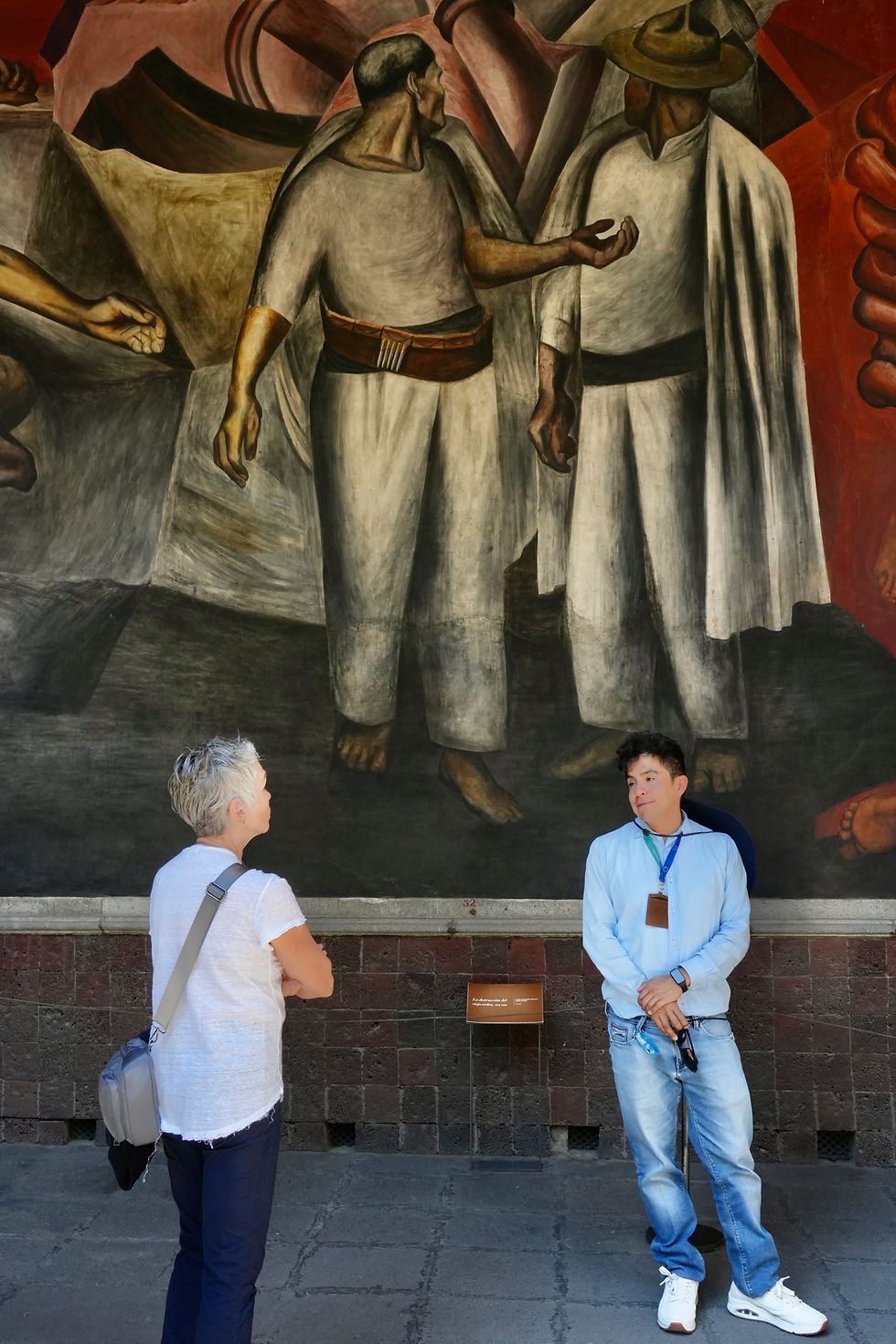
Right alongside The Destruction of the Old Order, this floor contains Orozco's most widely recognized masterpiece:
The Trench (La trinchera): This is one of the most powerful images of the entire Mexican Muralism movement. It depicts three revolutionary soldiers against a stark, blood-red background. One is fallen, one is kneeling in exhaustion or grief, and the central figure is collapsed diagonally over a stone barrier, his arms spread out in a shape that deliberately evokes a crucifixion. There is no political triumph here—only absolute, heartbreaking sacrifice.


The Revolutionary Trinity (La trinidad revolucionaria): A deeply cynical look at the forces of the Revolution. It features a soldier blindly holding a rifle (his eyes obscured by a red flag), a peasant kneeling in despair with his hands severed, and a worker looking on helplessly. Orozco is arguing that the ideals of the revolution have blinded its fighters and mutilated the working class.

In the early 1920s, fascism was just beginning to rear its head in Europe (Mussolini took power in 1922, and Hitler's Munich Putsch happened in 1923). Orozco was so tuned into global politics that he threw these emerging symbols straight into his pile of "human garbage" alongside the old crowns, decaying decrees, and religious crosses, predicting exactly where world ideologies were heading.


The Second Floor: Scathing Political Caricature
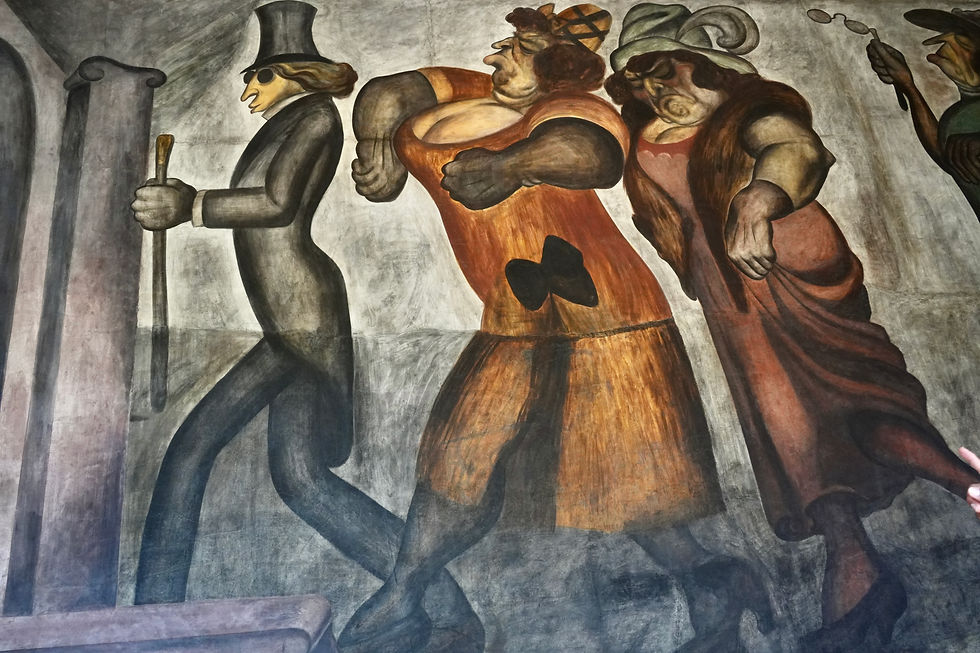
On the middle level, Orozco’s tone shifts completely from somber tragedy to biting, grotesque satire. He uses this floor to tear down the hypocrisy of both the old aristocracy and the new political elites.
The Banquet of the Rich (El banquete de los ricos): A savage caricature showing a group of bloated, decadent elites laughing, drinking, and poking fun at each other, completely oblivious to or mocking the starvation of the lower classes.


The Aristocrats (Los aristócratas): A similarly biting piece depicting upper-class society as stiff, superficial puppets with hollow faces, dressed in ridiculous finery while stepping over a pile of gray rags meant to represent the ignored, destitute masses.

The Franciscan and the Indian


Comments